Retreading Extruder Guns: The Tool That Makes or Breaks Your Skive Repairs
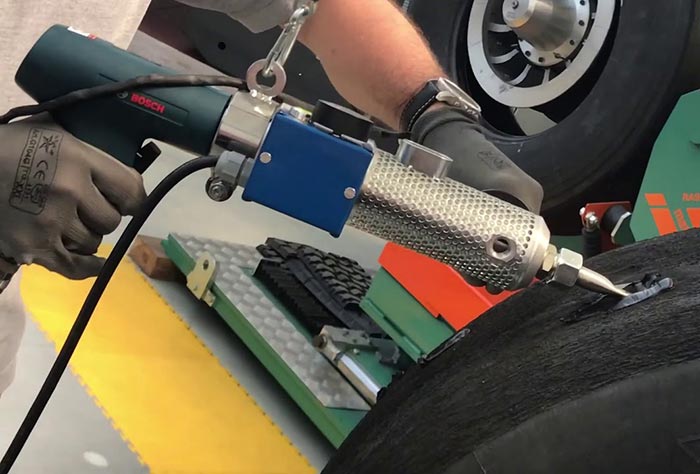
Retreading Extruder Guns: The Tool That Makes or Breaks Your Skive Repairs
If you're evaluating extruder options for the first time, or reconsidering what's already on your shop floor, here's what you need to know.
What a Retreading Extruder Gun Actually Does
After a casing has been inspected and buffed, any injuries - nail holes, skives, craters from cuts or punctures - need to be filled before new tread can be applied. Even small voids are a problem. Leave air trapped under the new tread or within a section repair, and you're setting up a failure point that heat, pressure, and road flex will eventually exploit. Rust, cord separation, and premature delamination are all downstream consequences of inadequate fill.
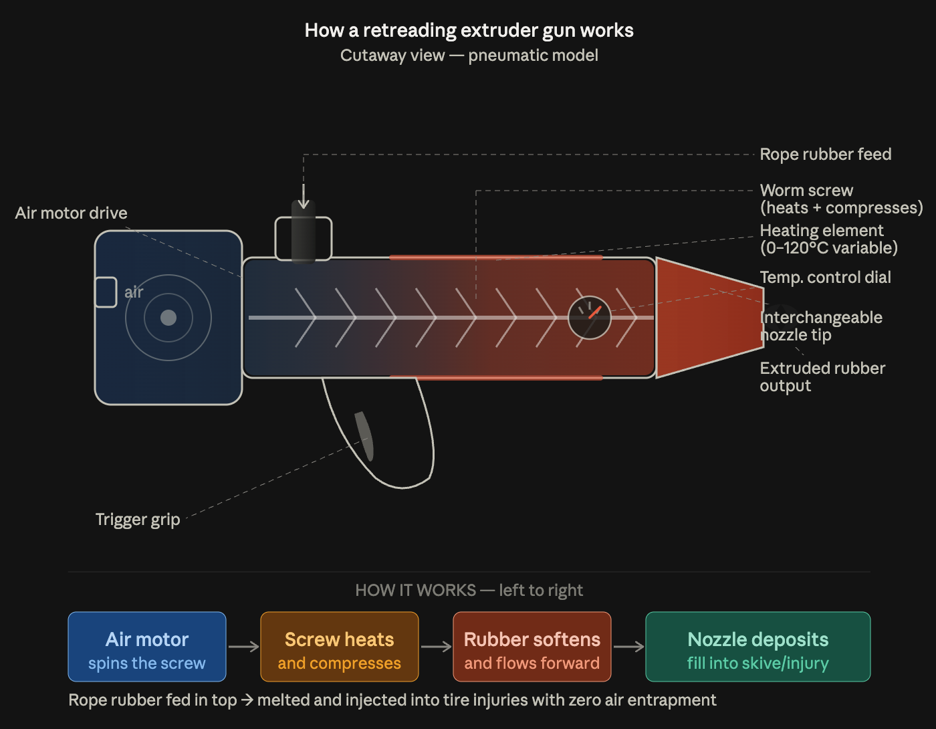
The extruder gun solves this by melting rope rubber or filler rubber stock through a heated worm screw inside the barrel, then pushing it out under controlled pressure through an interchangeable nozzle sized to match the injury. The result is dense, air-free rubber fill that bonds cleanly to the cemented injury and vulcanizes into a permanent repair during the cure cycle.
The feeder worm inside the barrel is specifically designed for heating, compressing, and mixing the rubber before it exits the tip - which is what separates a quality extruder from a tool that just pushes warm rubber around.
Pneumatic vs. Electric: Choosing the Right Drive
Pneumatic extruders use compressed air to drive the motor, with an electric heating element warming the barrel. They're the most common type in busy retread shops because they're lighter, easier to service, and well-suited to environments where air lines are already run throughout the facility. The tradeoff is air supply stability. If the air supply is not stable, rubber output can become uneven, which slows repairs and can compromise fill quality. These are usually setup with 110v in the US powering the air drive.
Electric extruders eliminate the air supply variable entirely, running solely on electricity. They tend to produce more consistent output in environments where air pressure fluctuates, and higher-wattage electric models can handle heavier rubber stock and larger skive volumes without the output drop you sometimes see in pneumatic tools during periods of high shop air demand. This setup is very rare in a retread shop.
For most commercial truck retreading operations, a well-maintained pneumatic extruder paired with a stable air supply is the practical choice. For OTR retreading - where the injuries are larger, the rubber volume per fill is higher, and consistency is critical given the cost of the casings - a higher-output electric model often makes more sense.
Salvadori: The Industry's Former Benchmark
The Salvadori Rubber Extruder Gun is considered the gold standard within the tire and wheel industry, used globally on section repairs on commercial truck tires and OTR tires, and widely throughout the tire retreading market. That reputation isn't marketing - it's been validated by technicians working on some of the most demanding repair applications in the business.
The Salvadori Normal Extruder Gun (750W) is specifically recommended for commercial truck retreading, designed to extrude uncured rubber into damaged areas on rubber surfaces. It works with TRRS, LRRS, and other rope rubber types and is known for its strong, steady flow and tool longevity. According to TECH Tire Repairs' senior technical trainer, the Salvadori drive system maintains a high flow that makes for a smoother repair and minimizes the time required by the technician to perform it.
Salvadori - part of the TRC family of brands alongside TECH Tire Repairs - offers a full product line that includes mini extruders for nail hole filling, standard-size guns for section repair fill, and higher-output models for OTR applications. In the retreading repair phase, extruder guns are used to fill possible craters alongside carbide cutters, air buffers, and grinding stones - making the extruder a core piece of the broader repair toolkit rather than a standalone specialty item.
Salvadori's spare parts inventory are accessible through McGee Compay along with their extruder guns.
VM Rubber
VM Rubber makes some great extruders as many engineers from Salvadori designed the line and improved on Salvadori specifications. Tried and true design, VM Rubber utilizes the premium Bosch drivers unlike Salvadori that has moved to their own in house design. Bosch drivers are the name trusted in the industry since extruders became a necessity in a retread shop. VM Rubber’s spare parts inventory are accessible through McGee Compay along with their extruder guns.
VM Rubber offers three main models for your retreading needs.
-
EX11780 - NAIL HOLE EXTRUDER GUN 110V W/BOX
-
Built for nail hole fills and small-diameter repairs on light truck and truck tires, this extruder gun handles natural rubber applications with consistent output and minimal setup. Mount it on the wall or clamp it to a work table - the adjustable angle keeps the tip where you need it, regardless of how your bench is laid out. Five interchangeable tips cover the range of hole sizes you'll encounter day to day, so technicians aren't swapping guns mid-repair. Straightforward to maintain, competitively priced against self-heating models, and proven in high-volume shop environments.
-
-
EX11961 - BOSCH MINI EXTRUDER GUN 110V 550W
-
Workhorse in any shop, this 550W Bosch driven extruder can handle being used nearly non-stop shift after shift. Conceived for filling up cavity, they allow not only to save working times, but also to assure a whole elimination of the air, obtaining a perfect adhesion and evenness of repairs. Optimal for larger fills on truck tires, this is your most versatile unit.
-
-
EX11960 - BOSCH OTR EXTRUDER GUN 110V 750W
-
This unit features a high quality drive, and adjustable heat controls for mostly Earthmover applications but is designed to be up and running nearly continuously. With a reliable Bosch driver, you can’t go wrong with this unit either.
-
Jet Extruder
Jet offers a great value line extruder for small to medium output shops that is powered by a CP driver. Jet is part of the Elgi umbrella that offers top quality blades by Pincott, Jet Envelopes, and Jet soft tire repair materials. Jet is manufactured in the US in a few locations, India, and Brazil to the same standards with retreading in their DNA at Elgi.
What to Look for When Buying an Extruder
Whether you're outfitting a new plant or replacing aging equipment, a few specs deserve attention before committing to a purchase.
Output rate. Measured in lbs/hr, rubber output determines how fast a technician can fill a skive or section repair. Standard truck tire repairs can be handled adequately by guns in the 39 lbs/hr range. OTR repairs - where a single crater might need a significant volume of fill - benefit from higher-output tools. Matching output to your typical repair volume prevents the technician from waiting on the gun.
Temperature range and control. Better extruders offer variable temperature adjustment rather than a fixed setting. Different rubber stocks have different optimal working temperatures, and a gun that can be dialed in precisely prevents over-softening (which weakens the fill) or under-heating (which creates poor adhesion and difficult flow). Look for a range that covers approximately 32°F to 250°F (0–120°C) at minimum.
Drive brand and parts availability. Pneumatic extruders powered by well-known industrial drive brands - Bosch, Chicago Pneumatic, Ingersoll Rand - tend to be easier to service because replacement parts are widely stocked. A proprietary drive with limited parts availability might cost less upfront and cost significantly more over its service life.
Nozzle compatibility. Different repair types need different nozzle profiles. A gun that supports a range of interchangeable nozzles - narrow for nail holes, wider for skives, contouring tips for shoulder builds - gives a technician the flexibility to handle varied damage without switching tools.
Weight and ergonomics. Retreading technicians use extruder guns for extended periods during busy production runs. A gun that's heavy or awkward to hold leads to fatigue, inconsistent fill technique, and slower cycle times. Mini extruders for nail-hole work typically weigh around 7-9 lbs; full-size guns for section repair fill run heavier, closer to 13 lbs. Both should feel balanced in use.
Where Extruders Fit in the Retreading Process
It's worth being clear about where extruder guns fit in the overall retreading workflow, because buyers sometimes confuse the handheld extruder gun with the stationary extruder machine used in mold-cure systems.In the mold-cure (hot process) retreading system, a large industrial extruder machine applies a continuous layer of uncured rubber compound directly to the buffed casing before it goes into the press. This is a production machine, not a handheld tool, and it's a different category of equipment entirely.
The handheld extruder gun covered in this article is used during the repair phase - before tread application in either the hot or cold process. After a tire is buffed, the buffed tire casing needs to have any injuries cleaned out and filled, and the extruder gun is the tool that does that filling before cushion gum is applied and the new tread goes on.
In the precure (cold process) system - the dominant method for commercial truck retreading in North America - the handheld extruder gun is indispensable. Every injury that isn't properly filled before enveloping is a potential void under the new tread. Extruder fill, done correctly, eliminates that risk.
The Bottom Line
The extruder gun is a relatively modest line item in a retreading plant's capital budget. It's also one of the few tools where a quality gap shows up directly in cure quality, casing survival rates, and finished tire safety.Shops that run Salvadori guns - and maintain them properly, with clean nozzles, calibrated temperature settings, and appropriate rubber stock - consistently produce cleaner repairs with less rework than shops running lower-grade equipment. That's not a coincidence. It's the difference between a tool that was engineered for this application and one that was priced for it.
If you're building out a retread operation or upgrading existing equipment, the extruder gun is one place where spending the extra money upfront pays for itself faster than almost anywhere else on the shop floor.